
The Mocka case study: how we lifted ROI 70% by fixing what most people ignore
Over the first twelve months working with Mocka, ROI climbed 70% in New Zealand and 35% in Australia, and we drove $1.4M in incremental revenue off $195k in media spend, running at a 15 to 30x return.
Those are big numbers, so let me tell you the unglamorous part, because that’s the bit that’s actually useful to you.
Where Mocka started
Mocka sells homewares and kids’ furniture across Australia and New Zealand. When we started, the account wasn’t broken. It was busy. Campaigns running, budget going out the door, revenue coming in, but no real logic underneath it about which products deserved which spend, or which market was actually carrying the account.
That’s a more common situation than a genuinely broken account, and in some ways a harder one. There’s no obvious fire to point at. Just a lot of activity that isn’t pulling in the same direction.
The problem was never the ad account
I say this to nearly every founder who lands in my inbox convinced their ads are the problem. The account is hardly ever the real constraint.
With Mocka, the money was going out fairly evenly across product categories that were nothing alike. Some categories had far better margins, far stronger demand, and far more room to scale than others, and the budget wasn’t reflecting any of that. We were spending like every product was the same product.
So the first move wasn’t a clever new campaign. It was segmentation. Splitting the catalogue into categories that actually behaved differently, then pointing the budget at the ones that could carry it.
That sounds obvious written down. It’s the thing almost nobody does, because it’s slower and less exciting than launching something new.
What I actually built
A full-funnel strategy on Meta, with retargeting support on Google so the two channels worked together instead of quietly competing.
Underperforming campaigns got rebuilt rather than paused and forgotten. The whole account got restructured, from campaign architecture through to creative direction and messaging. And every category got budget in proportion to what it could actually return, not an even split for the sake of a tidy spreadsheet.
Then tailored messaging per segment, A/B testing, and landing-page conversion points cleaned up so the traffic we were paying for didn’t leak out at the last step. Performance tracked continuously, so when something moved we adjusted in real time rather than finding out at the end of the month.
None of that is a single silver bullet. It’s a lot of unglamorous decisions made in the right order.
The numbers
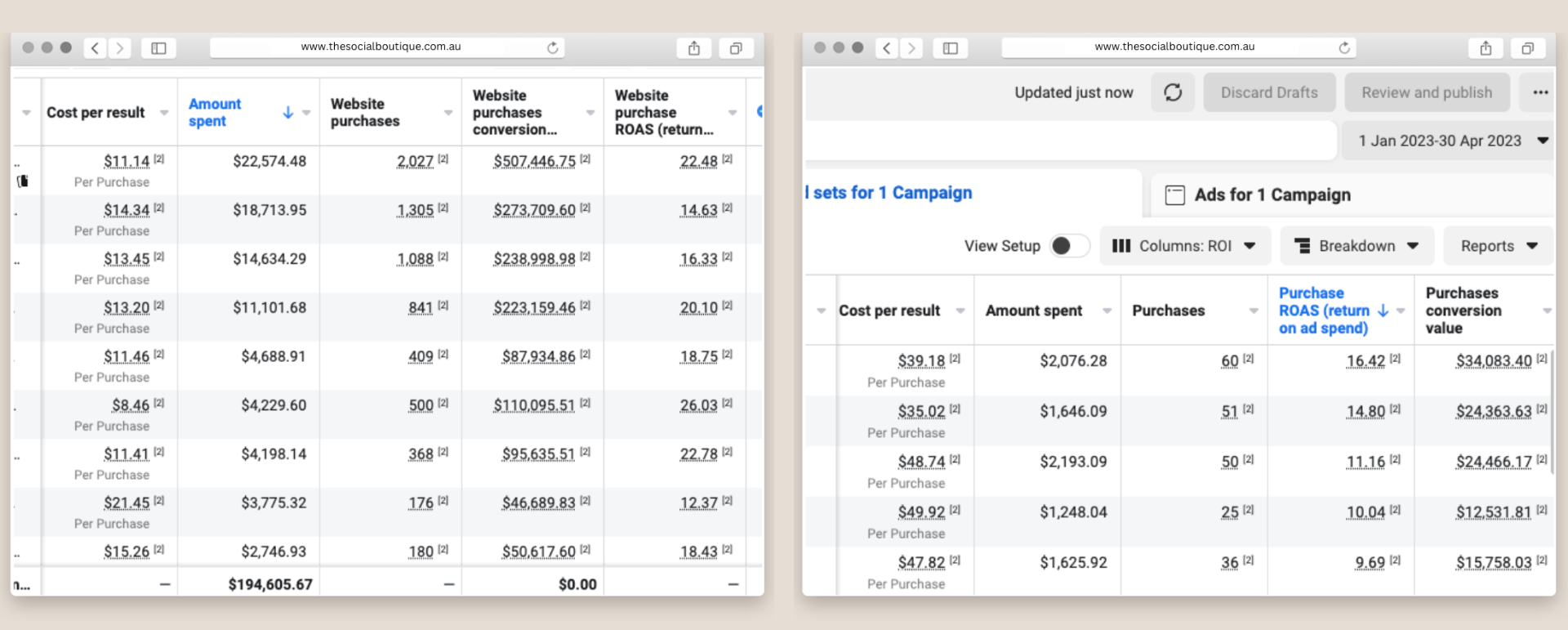
70% ROI lift in New Zealand, 35% in Australia $1.4M incremental revenue $195k media spend 15 to 30x return on ad spend
Why it worked
The honest answer is that we stopped treating the account like one thing.
A homewares brand and a kids’ furniture brand are not the same business, even when they live under the same roof. Different buyers, different price points, different seasons, different margins. Once the account was structured to respect that, the budget could finally flow to where it earned the most, instead of being smeared evenly across everything.
The Australia and New Zealand split matters here too. They’re different markets with different competition and different demand, and treating them as one number hides which one is actually working. Separating them is part of why the New Zealand lift came out so much stronger than the Australian one. We could see it, so we could feed it.
That’s the whole thing, really. Most of the growth didn’t come from finding something new. It came from seeing clearly what was already there and stopping the waste.
What this means if you’re not Mocka
I’m not going to promise you $1.4M. That number belongs to Mocka’s specific situation, their category, their margins, the room they had to grow. Anyone promising you a number before they’ve seen your business is guessing, or selling.
What carries over is the discipline underneath it.
Segment before you scale. Spend in proportion to what a category can actually return, not evenly for neatness. Treat different markets as different markets. Rebuild what’s underperforming instead of leaving it running. Track closely enough to move quickly.
That’s what I’d bring to any account doing similar volume. It’s also the part most agencies skip, because it’s slower and less impressive than a big launch, and it doesn’t fit neatly onto a case study slide.
If your account is spending across a range of products or markets and you can’t confidently say which one is carrying the rest, that’s usually where the easy growth is hiding. And it’s rarely the fix people expect.
Book a discovery call with me here. I'll look at your ad account and your business numbers together, and tell you straight where the real opportunity sits.
Additional resources
The Meta ads metrics that actually matter (and the ones to ignore)
The Meta ads campaign structure that actually works for ecommerce in 2026